Get news, updates, and insights delivered straight to your inbox.
AI in MarTech: Intelligent Marketing Technology

Artificial intelligence has officially crossed a threshold in marketing technology. AI in MarTech is mature, readily available, and essential if you want to manage your brand with the speed required to thrive in today’s market.
With the right stack, you can manage assets in real-time, take advantage of AI tools to power your marketing strategies, and personalize customer experiences like never before.
Now isn’t the time to ask whether you should adopt AI. That time has long passed. Instead, you need to apply it responsibly and identify the right tools for the job. Here’s everything you need to know when investing in AI in marketing technology.
What Is AI in MarTech?
AI in MarTech refers to the use of artificial intelligence capabilities, such as machine learning and natural language processing, embedded directly within marketing technology. These capabilities allow you to make decisions faster, precisely govern your assets, and execute like never before.
Traditional marketing automation tools follow predefined rules and rigid workflows. AI-enabled MarTech systems adapt using robust algorithms. They can evolve based on how your team uses assets, customer data, and predictive analytics insights. The result is a smoother customer journey and a better content creation workflow.
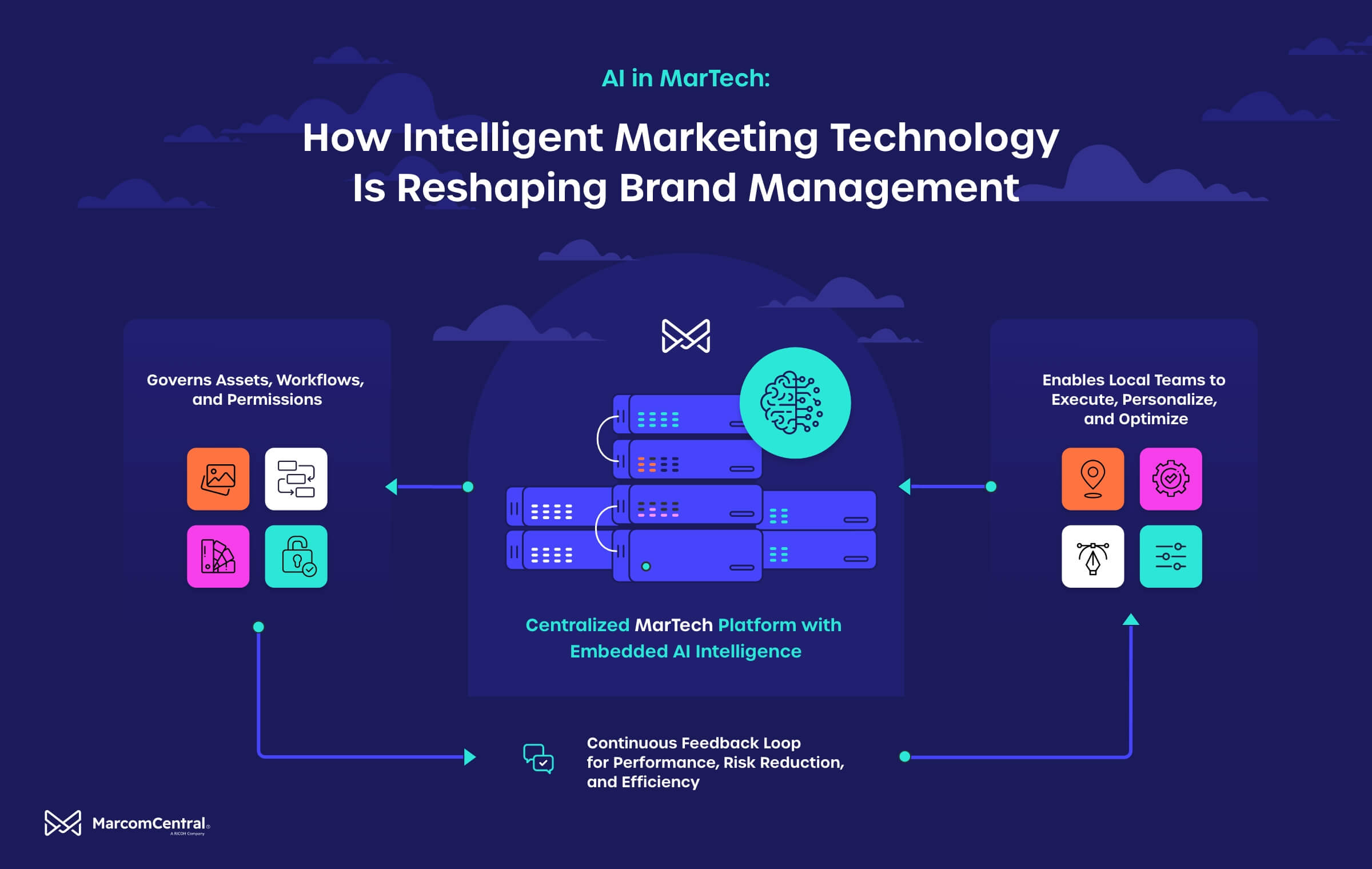
Before you explore AI in MarTech, it’s important to distinguish between AI-driven intelligence and adjacent technologies:
- Automation executes predefined actions
- Analytics reports on past performance
- AI identifies patterns, predicts outcomes, and recommends actions in real time
The most effective applications of AI in MarTech are embedded capabilities within systems of record. Examples include brand management platforms and asset management systems. In these use cases, AI can operate with full context and governance.
Why AI in MarTech Matters Now
Marketing teams are facing a convergence of operational pressures that traditional tools were never built to handle. Here’s why your business needs AI in MarTech:
Marketing Complexity Has Outpaced Manual Processes
Your business operates across more channels than ever, including social media, email, your website, and paid ad platforms. Additionally, your marketing team manages thousands of assets and supports teams that are spread across different regions. Manual decision-making and approval workflows simply can’t keep up. They don’t scale to that level.
The introduction of artificial intelligence into content creation has exacerbated the problem, as marketers can create high-quality assets faster than before. AI helps bridge this gap by reducing manual workflow while streamlining how you tag, manage, and distribute assets.
Speed, Scale, and Brand Control Are Now Competing Priorities
Marketing leaders are expected to move faster and personalize more. However, you have to put your local teams in a position to succeed without diluting the brand.
Historically, speed and control have been at odds. AI integration changes that dynamic, allowing you to exercise tight control while also working faster.
Investing in AI in MarTech gives you a competitive advantage. You can reinforce key governance protocols and protect brand equity while also empowering local teams to customize assets based on their target demographics. The result is more impactful marketing efforts and greater engagement at every touchpoint.
Core AI Capabilities Powering Modern MarTech Stacks
Artificial intelligence is most effective when you organize and deploy it around specific outcomes. Here are the core capabilities powering today’s top MarTech solutions:
Machine Learning & Predictive Intelligence
Machine learning and predictive capabilities are baseline offerings for artificial intelligence. In MarTech environments, this can support:
- Predicting asset demand by campaign or region
- Identifying high-performing content variations
- Anticipating lifecycle needs for creative refreshes
You can turn your marketing department into a proactive team that plans ahead, instead of scrambling to catch up.
Natural Language Processing (NLP)
NLP enables systems to understand and process human language. In turn, your content becomes easier to organize and retrieve. NLP technology can also assist with tagging for segmentation purposes.
Natural language processing also promotes intelligent search and content discovery, enabling your teams to find the right assets with less effort.
Content generation is more efficient than ever before. NLP helps you manage your content by improving data quality and keeping the entire ecosystem more organized.
Generative AI (Applied Responsibly)
Gen AI receives the majority of attention when talking about the use cases for artificial intelligence. While gen AI is powerful for creating content, it also has applications in MarTech, such as:
- Adapting approved content for regional needs
- Creating descriptions or summaries of assets
- Promoting localization
When you implement sound brand rules and approval workflows, generative AI allows you to execute faster without diluting brand equity. However, businesses that turn generative AI technology loose are going to create new challenges rather than solve existing ones.
AI-Driven Workflow & Automation Intelligence
AI can optimize workflows by identifying bottlenecks and improving your routing processes. IT can also deliver actionable insights and metrics so you can identify otherwise undetectable challenges.
Over time, these backend challenges will lead to better campaign performance and improved efficiency across all teams.
Where AI Creates the Most Value for Marketing Teams
With all the buzz about artificial intelligence, it can be tough to know where to implement it first. Here are some of the most exciting use cases for AI in MarTech:
Brand Governance at Scale
Maintaining messaging consistency and achieving scalable governance represent two of the greatest hurdles for brands of all sizes. Enforcing these standards becomes even more complex if you are working with regional or distributed teams. AI helps you maintain consistency by supporting policy enforcement and managing permissions.
Additionally, artificial intelligence gives you the ability to implement governance rules without relying solely on manual reviews. AI augments your governance capabilities by identifying risks earlier in the process.
Asset Management & Findability
Marketing teams lose countless hours searching for assets or recreating content that already exists. AI-powered asset management improves findability by making your content easier to search, understand, and reuse.
Campaign Execution Across Distributed Teams
Decentralized teams need flexibility to customize assets, but not so much freedom that they dilute the brand. AI supports localized personalization without compromising brand integrity. The technology will help your staff find approved assets, customize templates, and reach local audiences.
Performance Measurement & Optimization
With AI in MarTech, you can determine which assets are performing and which are not. Connect marketing campaign achievements to specific assets. Use this information to help regional teams capitalize on new trends and drive better engagement.
AI in MarTech vs. AI Point Solutions
There is an important distinction between AI in MarTech and point solutions. Implementing a separate point tool for every problem leads to sprawl, which creates all sorts of new technology and governance headaches. Disconnected solutions can also go unused or get lost in the shuffle, meaning you will suffer a diminished ROI.
Investing in AI in MarTech is the wiser decision, as it allows you to avoid these risks. When artificial intelligence lives within your systems of record, it creates a unified experience for users and marketing teams.
While there is nothing wrong with experimenting with AI point solutions, they are not a long-term solution. Don’t overinvest time or resources in niche tools, but instead prioritize MarTech with embedded artificial intelligence capabilities to support your organization’s needs over time.
The Risks of AI Without Governance
Artificial intelligence can never be allowed to run rampant within an organization or system of record. Without proper governance, you will encounter many of the same issues that you face when managing marketing assets manually. These threats include the following:
Brand Inconsistency and Compliance Risk
You’ve spent years building brand equity and creating a recognizable voice. If you work in a tightly regulated space, the value of your voice is even higher. Allowing artificial intelligence to run rampant within your systems and workflows can lead to consistency concerns and a risk of non-compliance.
Therefore, you need to implement clear guardrails for the AI. These rules are meant to keep the technology in bounds. When the AI has a clear playbook, it can deliver all of the benefits outlined above with very little risk.
Security, Privacy, and IP Ownership Concerns
Open-source AI models can be free or low-cost, but they don’t provide the level of security necessary to protect your brand or its intellectual property. Carefully vet prospective solutions so that you can promote data privacy and address IP ownership concerns.
Low-Quality Output and Eroding Brand Trust
Gen AI can pump out a huge volume of content, but it’s up to you to make sure the material meets your quality standards. Publishing low-quality content will erode consumer trust and make it more difficult to engage with your target audience. Once that trust is lost, it can feel almost impossible to get it back.
Best Practices for Adopting AI in Your MarTech Stack
If you are ready to integrate artificial intelligence into your MarTech platform, follow these best practices to set yourself up for success:
Start With Core Systems, Not Isolated Tools
Embedded AI needs to be the standard from day one. Don’t waste time on isolated tools that solve niche challenges. Revamp your foundational systems so that you can reshape how your marketing staff creates, governs, finds, and retrieves content.
Align AI With Real Marketing Workflows
Artificial intelligence needs to fit your real-world processes, not the other way around. Don’t try to reinvent the wheel to make a flashy new AI tool fit into your marketing model. That approach creates instant change resistance. Find AI solutions that are flexible and adaptable.
Keep Humans in the Loop
Artificial intelligence in MarTech is meant to empower your team to make smarter decisions faster. They never need to be pushed out of the loop. Leave final decisions up to humans, not machines. They will provide valuable quality control and make sure that assets fit the preferences of your target audience.
Measure Time Saved and Risk Reduced
If you want to build momentum for future marketing efforts, track your progress. Focus on metrics like time saved and risk reduced or avoided. When you boil down the impact of AI to business-wide performance points, you will have a much easier time getting the C-suite to support your next AI-driven proposal.
How MarcomCentral Enables AI-Driven MarTech
MarcomCentral empowers your organization to embrace the next generation of artificial intelligence technologies. You can integrate AI into your content management technologies to support brand control and increase operational efficiency.
Additionally, MarcomCentral reduces friction across campaign execution and asset management. Your team will be able to focus their time on more valuable work that drives results for your brand.
Frequently Asked Questions About AI in MarTech
How Is AI in MarTech Different From Traditional Marketing Automation?
Traditional automation technologies are designed to expedite specific processes or niche workflows. While they deliver value, marketing automation tools are niche.
AI in MarTech offers systemic improvements to the way you create assets, tag content, and retrieve materials for campaigns. It represents a total reimagining of the way brands manage the content that they use to engage with consumers.
What Problems Does AI in MarTech Actually Solve for Marketing Teams?
AI in MarTech reduces manual work and improves asset findability. With the right rules in place, AI also supports your governance protocols, which is critical for protecting brand equity. You can also use it to scale content production and execution without going off the rails.
What Should Marketing Leaders Look For in AI-Powered MarTech Platforms?
When searching for MarTech with AI capabilities, look for embedded systems. The artificial intelligence tools need to be completely integrated, not treated like an afterthought.
Explore AI-Powered Brand Management With MarcomCentral
AI works best when you apply it responsibly. That means using a platform that is designed to support brand control and scalability. MarcomCentral brings together world-class asset management capabilities and the power of artificial intelligence to promote efficiency and protect your brand. Change the way you manage assets and connect with consumers with AI in MarTech.
Explore MarcomCentral’s AI-powered solutions. Ready to put our platform to the test? Request a demo to experience MarcomCentral.
You might also like