



Get news, updates, and insights delivered straight to your inbox.
Understanding the Modern MarTech Stack

Digital marketing is more technology-centric than ever before. From managing customer data to automating campaigns and tracking performance, you rely on a wide range of tools working together behind the scenes.
When this collection of platforms forms smooth workflows, you can bring your marketing strategy to life across every core channel. But without a strong marketing technology stack, campaigns may fall flat.
Organizations that rely on disconnected tools lack the functionality to effectively manage SEO, email marketing, paid campaigns, and social accounts. To win, you need a modern MarTech stack that brings resources together and provides unparalleled visibility. A well-structured stack enables you to improve campaign performance and deliver better customer experiences at scale.
Our guide explores what a modern marketing technology stack looks like, why it matters, and how you can build and optimize your stack for long-term success.
What Is a Modern MarTech Stack?
A marketing technology stack refers to the collection of software and tools that you use to plan, execute, measure, and optimize marketing activities. These technologies support everything from managing your website to analytics and email campaigns.
A modern MarTech stack is your centralized resource for collecting data, automating processes, and delivering content in a way that resonates with your target audience.
Over the past few decades, marketing technology has become more data-driven and integrated. Early digital marketing efforts relied on standalone tools, each of which was built to streamline a specific task. While these tools worked when the digital marketing landscape was simpler, they became impractical as additional channels and strategies came about.
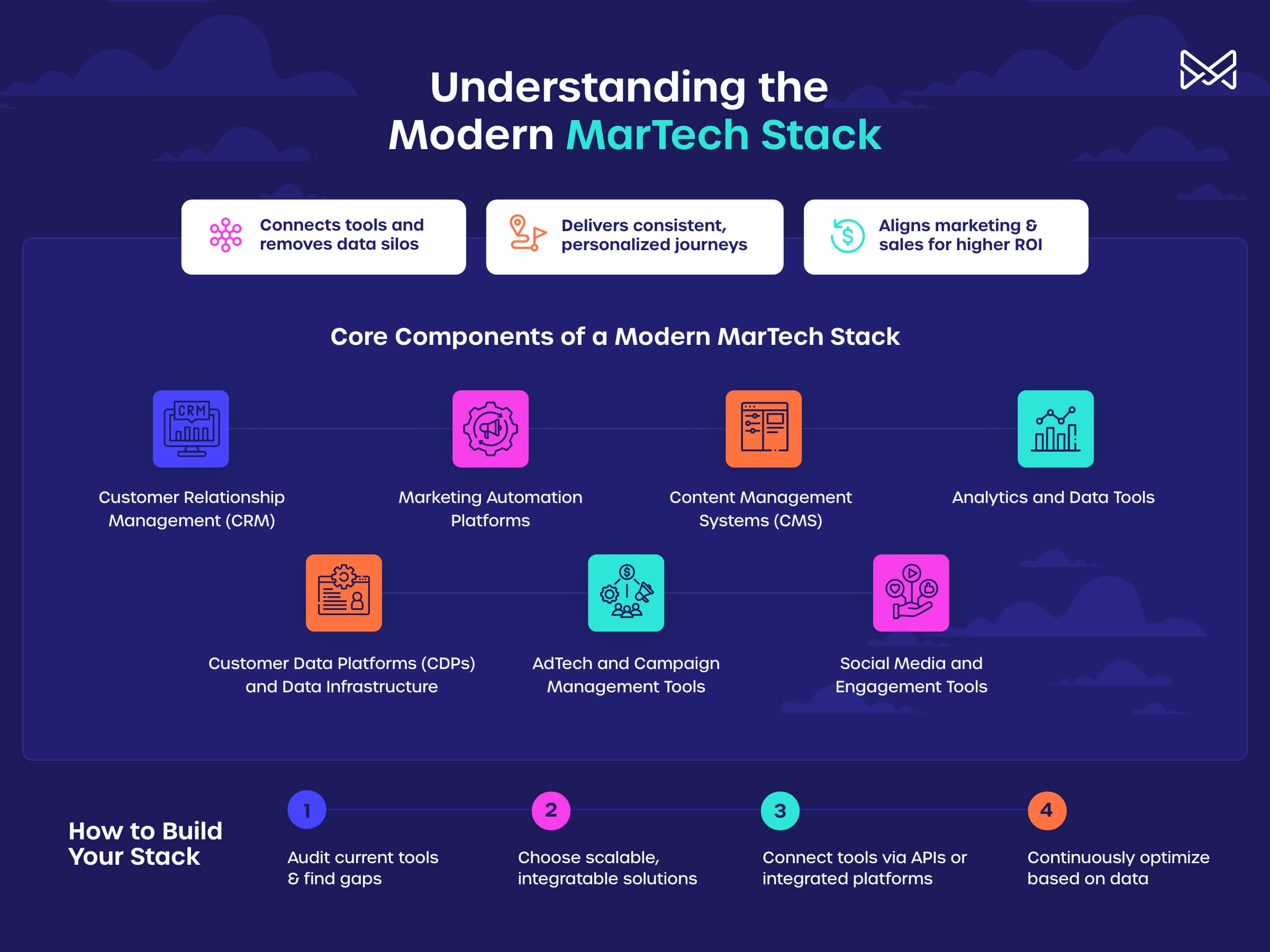
The solutions landscape came full circle, resulting in the creation of integrated marketing technology stacks. Instead of being left with disconnected tools, your team can tap into everything it needs in one connected ecosystem. When you bring all of these resources together, you can:
- Track the entire customer lifecycle
- Measure campaign performance in real-time
- Identify high-value leads and opportunities
- Improve marketing attribution
Your marketing team can operate with greater efficiency and deliver better customer experiences.
Why the Marketing Technology Stack Matters More Than Ever
Businesses that are using disconnected marketing tools are at a stark disadvantage. Here’s why you need a cohesive marketing technology stack:
- There are more channels and customer touchpoints than ever
- Your marketing strategy must be data-driven and rely on measurable metrics
- Customers demand personalization in real-time
- Your marketing and sales teams need to be on the same page
- Silos diminish the customer experience
When you bring all of your technology tools together, customers enjoy a better, more aligned journey with your brand.
Core Components of a Modern MarTech Stack
When you begin your search for a marketing technology stack, make sure that it includes the following components:
Customer Relationship Management (CRM)
A customer relationship management platform lays the foundation for all of your customer interactions. The right CRM will:
- Provide a hub to gather customer data and track the lifecycle
- Support lead generation, scoring, and customer retention
- Get your sales and marketing teams on the same page
Examples of popular CRMs include Salesforce and HubSpot. These platforms offer plenty of native integrations and APIs to support integration at scale.
Marketing Automation Platforms
Next, you need a tool to manage your marketing campaigns at scale. When you can effectively connect with your target audience via email campaigns, automate outreach, and simplify onboarding, every touchpoint becomes more effective. The key is reducing the administrative burden on your team and taking redundant work off their plate.
Marketing automation platforms also enable you to support performance tracking and attribution. Tools like Marketo and HubSpot enable you to promote better customer engagement through personalized automation. When these tools are connected with Google Analytics, you gain an even better look into what’s working, what’s not, and how to solve those challenges.
Content Management Systems (CMS)
A content management system brings together all of your deliverables into one organized location. You can identify which assets are promoting the strongest customer engagement, conduct data analysis to make your Google Ads more effective, and continually refine how you connect with your audience.
CMS technology supports SEO and content marketing initiatives, especially if you are working with a decentralized team. WordPress and Adobe are examples of effective CMS platforms.
Analytics and Data Tools
Data analysis represents one of the most important facets of marketing in today’s environment. Consumers have so many different brands competing for their attention and their money. When you can measure campaign performance and attribution to gain customer journey insights, you can refine future marketing efforts to be more impactful.
Google Analytics and Tableau are two of the most well-known options. These tools connect business intelligence to customizable reporting dashboards, enabling you to emphasize information most relevant to your marketing goals.
Customer Data Platforms (CDPs) and Data Infrastructure
CDPs centralize your customer data from everywhere, including email, your website, paid ads, and social media. When you connect your CDP to your data infrastructure, such as a data warehouse or data lake, you can enrich information from all sources to gain a more complete view of your audience.
Segment and customer data platforms are must-have options when dealing with high volumes of consumer information. You can deliver a unified customer experience that spans across all marketing channels.
AdTech and Campaign Management Tools
Paid ads on Google Ads, LinkedIn, and other channels give you the extra boost necessary to grow. A unified marketing technology stack will support A/B testing and provide insights that you can use for campaign optimization.
These tools should integrate with other marketing automation platforms to save time and promote overall efficiency. After all, new trends can emerge and disappear quickly. You need to be able to capitalize on them.
Campaign management tools can also improve attribution. They help you determine which efforts and ads are moving the needle in your favor.
Social Media and Engagement Tools
While social media marketing basics hold true across all of the main channels, nuance still exists. You need to tailor your efforts so you can connect with the right people, on the ideal channels, at the right moment in their journey.
No marketing technology stack is complete without social media and engagement tools. These solutions allow you to manage your social campaigns, coordinate messaging, and promote better engagement and outreach. You can use this visibility to align content with your broader marketing processes.
How the Modern MarTech Stack Supports the Customer Journey
A modern MarTech stack promotes a better customer journey by connecting the dots across every customer lifecycle stage and contact point. When you align your marketing campaigns with customer engagement strategies, the messaging is more likely to resonate with who you need to reach.
The right tech stack also opens the door for account-based marketing in B2B environments. Use it to support personalization and retention in the e-commerce space or deliver consistent experiences across every channel.
Breaking Down Silos: Creating a Connected Ecosystem
Information silos are your greatest enemy when implementing a marketing technology stack. When walls exist between your various platforms, blind spots are created. Integrated marketing technology stack components tear down these silos.
APIs that connect your applications and tools promote better visibility between sales and marketing. When these teams can see what the other is doing, they can more effectively collaborate and support one another. With that in mind, focus on connecting your CRM, marketing automation tools, and analytics platforms.
From there, work on creating seamless workflows across marketing teams. Improve visibility into campaign performance and marketing efforts so you can get more done.
The Role of AI in the Modern MarTech Stack
The world is buzzing about artificial intelligence, and has been for some time. This hype is justified, especially in the marketing space. With AI, you can optimize your workflows and run predictive analytics on mountains of customer data. Artificial intelligence also excels at scoring leads and segmenting audiences in meaningful ways that give you the most bang for your buck.
When you can automate data analysis and enrichment, it takes a huge load off your team’s plate. You can improve personalization across your most important marketing channels and support smarter decision-making when creating or refining your marketing strategy.
Building and Optimizing Your Marketing Tech Stack
Ready to create a tech stack that supports the next level of growth for your business? Start by taking stock of your existing MarTech tools. Identify gaps in functionality that could hinder your growth or allow data silos to persist.
Select new tools to close those gaps. Tie each tool to a specific problem you want to solve or a goal you want to achieve. Make sure those solutions are scalable and can grow with your marketing campaigns. Otherwise, it may become obsolete and hinder future marketing efforts. Your priorities should include integration, usability, and long-term optimization.
Common Use Cases Across the Marketing Technology Stack
Here are a few ways that modern marketing tools can add value to your tech stack. With the right tools, you can:
- Optimize your SEO efforts with tools like SEMrush
- Automate email marketing to nurture prospects throughout the full lifecycle
- Launch webinars and digital events with management tools
- Create account-based marketing campaigns
- Use data to attribute touchpoints to conversions and track performance
- Manage your social campaigns and distribute content at scale
Identify use cases that would deliver short and long-term value for your brand. Those are the solutions that are worth investing in.
Metrics That Matter in a Modern MarTech Stack
When implementing new MarTech tools, you should identify relevant metrics that reveal whether those solutions are offering a strong return. Here are metrics that actually matter:
- Monetary ROI
- Campaign performance
- Attribution modeling and multi-touch analytics
- Customer acquisition cost
- Retention rates
- Engagement across each channel
- Lifecycle conversion tracking
- Optimization benchmarks related to business intelligence
Add or modify these metrics based on the needs of your business. You need to watch enough data points to obtain a full picture, but not so many that you get lost in the information.
The Future of the Marketing Technology Landscape
MarTech tools are becoming more sophisticated and capable. However, the pool of solutions is also growing deeper, which can make it challenging to identify the right options for your business. A greater reliance on AI is becoming normalized across virtually every solutions provider.
When building your stack, pay close attention to tools that offer a tighter integration, such as modules or buttons that are embedded into your CMS. The goal is to make the entire experience feel native and seamless for your marketing team. Data unification is another common focus, as is customer relationship management.
Solutions like MarcomCentral can give you granular control over your assets and promote collaboration, even when your teams are distributed. Our platform readily integrates with top marketing tools to give you an edge.
Ready to learn more? Request a demo of MarcomCentral to get started.
FAQs
What Is Included in a Marketing Technology Stack?
There are several different technology configurations available, but a stack typically includes a CRM, automation tools, analytics capabilities, and a content management system. Modern options may also feature a customer data platform, advertising tools, and social media management capabilities.
How Do You Build a Modern MarTech Stack?
The easiest approach is to make a list of must-have features and tools. Next, identify capabilities that are nice to have. Find a few solutions providers that check all of the boxes for your team, and compare them to identify the one that is the best fit.
What Is the Difference Between a CRM and a CDP?
A CRM equips you with tools to manage customer relationships and sales interactions. A customer data platform centralizes information from multiple sources to create unified customer profiles, which you can use for marketing and personalization.
How Does Marketing Automation Improve Campaign Performance?
Marketing automation improves campaign performance by streamlining your workflows and delivering personalized messaging at scale. You can track customer interactions more effectively and use the power of data to meet customers where they are.
What Tools Are Essential for B2B Marketing Teams?
The specific tools you need will vary slightly based on the scope of your business and who your target audience is. However, some essentials include a CRM, automation capabilities, an analytics dashboard, and a content management system.
How Can Marketing Teams Eliminate Silos in Their Marketing Tech Stack?
Your marketing team can tear down silos by replacing disjointed tools with an integrated platform. Alternatively, you can connect existing solutions with APIs.
You might also like


AI in MarTech: How Intelligent Marketing Technology Is Reshaping Brand Management
Read More