Get news, updates, and insights delivered straight to your inbox.
AI for Digital Asset Management: How Intelligent DAM Systems Help Marketing Teams Scale

Marketing teams are producing more content than ever before, largely thanks to the support of artificial intelligence. While this influx of assets has given marketers more options, it has also created a backlog that needs to be organized. Fortunately, using AI for digital asset management is a viable solution.
With AI in DAM platforms, you can bring order to your growing library of assets and reduce operational friction. You will also be able to scale marketing efforts without sacrificing governance or brand control.
Embedding AI in digital asset management solutions does not replace people or processes. Instead, it helps your marketing team work smarter by automating tedious tasks and improving discoverability. Here’s everything you need to know.
What Is AI in Digital Asset Management?
AI for digital asset management refers to the use of machine learning and natural language processing to optimize how digital assets are organized. Artificial intelligence helps DAM platforms understand what assets are, how they should be used, and who should have access to them. You can tap into this functionality to automate workflows and reduce the need for manual inputs.
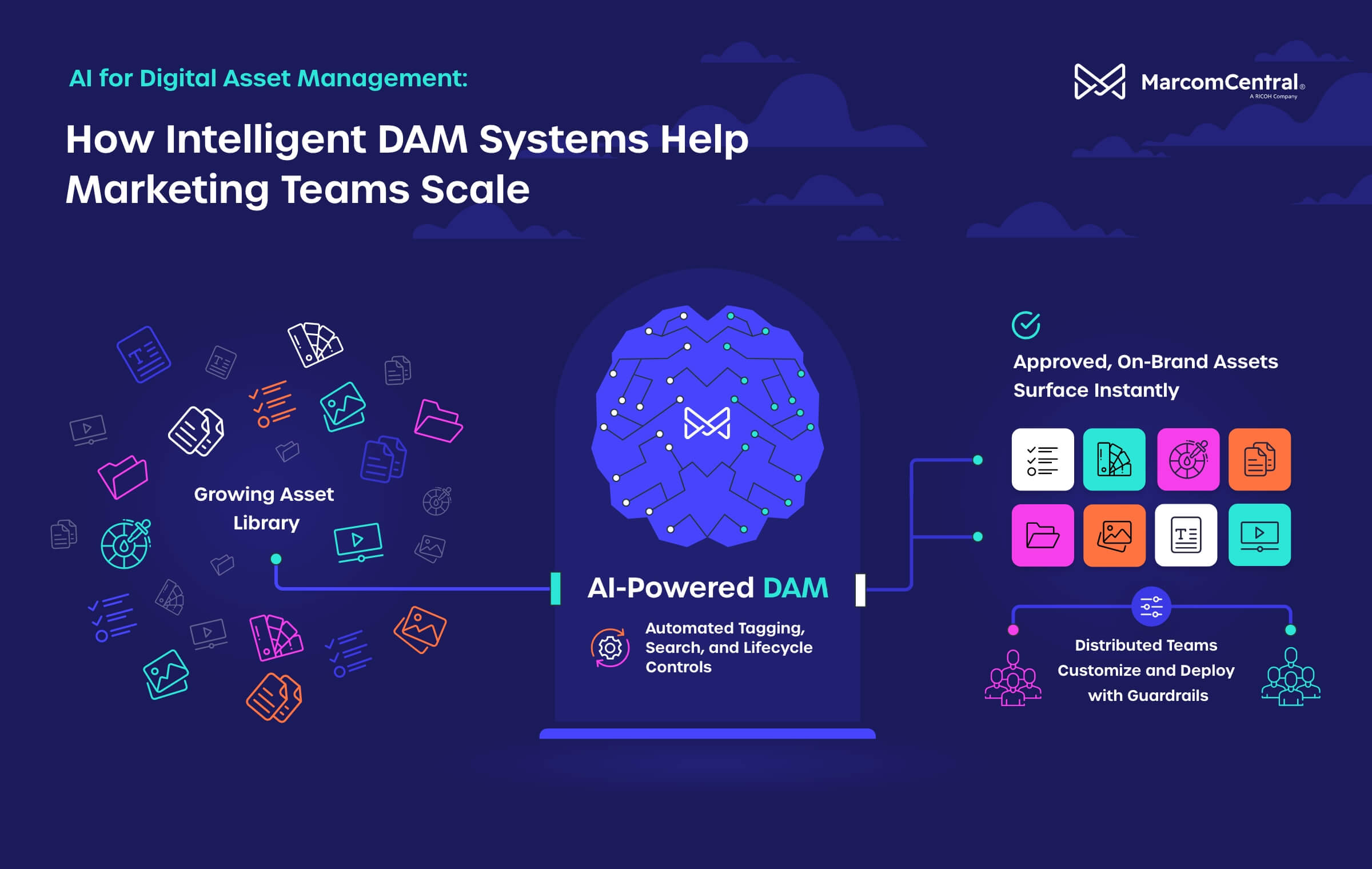
Traditional DAM systems depend heavily on your team going in and adding metadata, structuring folders, and setting up rules. An AI-powered DAM can more efficiently categorize content and streamline the way you manage assets. Your team will easily be able to find the assets they need without wasting hours sifting through files.
Why AI Is Becoming Essential to Modern DAM Platforms
AI tools are accelerating content creation, and traditional digital asset management systems cannot keep pace. The push toward using AI for digital asset management is in response to this challenge. Here’s a closer look at why DAM solutions are now incorporating AI technologies like never before.
Asset Volume Is Growing Faster Than Teams Can Manage
The volume of digital assets continues to grow rapidly. Unstructured data, including images, videos, and creative files, now account for a huge portion of enterprise data. AI-driven asset creation is making libraries balloon. Without AI-assisted organization and discovery, even well-designed DAM systems become difficult to navigate.
Distributed Teams Increase Brand Risk
If your creative teams are working remotely or from decentralized regional offices, maintaining brand compliance becomes a major challenge. These risks are compounded when agencies are brought into the fold.
Teams may rely on outdated assets or modify files incorrectly. If you are using rigid approval workflows, it can create tight bottlenecks. AI helps mitigate these risks by intelligently surfacing approved assets, enforcing permissions, and supporting governance rules. More importantly, AI won’t slow things down.
Speed Matters, but Governance Still Wins
As you can attest, marketing leaders are under constant pressure to move faster and produce more content. But increasing speed without the right supporting structure creates long-term problems. You will encounter inconsistent branding and redundant effort that wastes time and resources.
Using AI to manage your digital content allows you to work quickly and maintain tight governance. You can automate routine tasks while preserving your ability to oversee day-to-day work. The result is that your teams can capitalize on fleeting marketing opportunities while working within set guardrails.
Core AI Capabilities Powering Digital Asset Management
Here are some of the most exciting and impactful use cases of AI in DAM software:
Automated Metadata Tagging and Classification
One of the most immediate benefits of AI-powered DAM is automated metadata tagging. AI algorithms can use image recognition and text analysis to identify key attributes, such as:
- Visual elements
- Text within images or documents
- Usage context and asset type
This reduces the time spent on manual tagging and improves consistency. Your assets will remain searchable, no matter how much your content library grows.
Intelligent Search and Asset Discovery
Finding assets using a traditional keyword search means your team needs to know exactly what they’re looking for. Adding AI to the mix allows employees to find content with more natural queries.
AI-powered search facilitates natural discovery through visual similarity searches and relevance-based rankings. Users can find the right brand content faster, even if they don’t know the file name or exact metadata.
Workflow Automation and Lifecycle Management
AI also supports smarter workflows by improving the way you approve assets, control versions of content, and set expiration dates. Thanks to auto-tagging, you can set custom rules for document expiration and apply them to all assets of a specific category.
These features simplify content management and help you keep outdated assets out of marketing campaigns.
AI-Assisted Content Adaptation and Localization
AI supports scalability for marketers by empowering your teams to quickly identify reusable assets and customize them for local campaigns. They can apply generative AI to templates in real-time and incorporate the assets into their content strategy. You control what elements can be changed, which preserves brand equity.
Where AI Delivers the Most Value in Digital Asset Management
When integrating artificial intelligence into the mix, it’s important to stay focused and target the most high-value use cases first. Here are areas where AI delivers the best value:
Faster Access to Approved, On-Brand Assets
Your marketing team spends a huge amount of time on repetitive tasks, such as tracking down assets or recreating content that already exists. AI-powered DAMs improve content operations and grant faster access to approved, on-brand assets.
AI-powered DAM systems reduce friction by increasing searchability and clearly identifying which versions are approved for use. Your team can conduct a natural language query, choose from a list of available assets, and get to work on their next campaign.
Stronger Brand Governance at Scale
Artificial intelligence helps you enforce brand standards by ensuring that only approved assets are surfaced in results. Additionally, the platform will enforce your permissions and consistently apply usage rules across all locations and teams.
Improved Collaboration Across Teams and Partners
By centralizing all of your assets in one intelligent, user-friendly platform, AI can promote smoother collaboration. You can adapt the ecosystem to meet the needs of internal teams, external agencies, and regional partners, all without sacrificing control.
Better Insight Into Asset Performance and Usage
The top platforms provide comprehensive insights into which assets are being used and which are not. You can use this data to identify high-performing content and encourage regional teams to take advantage of these trends. You can also remove underperforming content from circulation and replace it with more engaging material.
AI in DAM vs. AI Content Tools: Understanding the Difference
Generative AI tools have made it easier than ever to create content. However, creating more assets can add to the chaos.
AI content tools generate files. DAM systems manage them. Adding artificial intelligence to your digital asset management platform helps calm the storm by reducing your reliance on manual tagging. Artificial intelligence-powered content creation tools made the problem, and AI in DAM solves it.
Risks and Challenges of AI in Digital Asset Management
There are always risks involved when you add artificial intelligence to a process or existing technology. Fortunately, they are all manageable when you are aware of them. These challenges include the following:
Brand Inconsistency and Compliance Gaps
Without proper governance, AI automation can surface or distribute assets that are outdated. To close these compliance gaps, you need to implement clear rules for your DAM. AI will only be as effective as the rules you implement.
Security, Privacy, and IP Ownership
Integrating AI technology into your existing DAM platform creates new digital connections, which can mean additional security risks. Make sure you choose a reliable solutions provider that operates within enterprise security standards. This is especially important when your DAM contains intellectual property and sensitive brand documents.
Over-Automation Without Human Oversight
Artificial intelligence should support human decision-making, not push your employees out of the equation. You can’t just turn the technology loose. The most effective DAM strategies keep humans in the loop for approvals and quality control. Strike the right balance to protect your organization’s interests and achieve a stronger ROI.
Best Practices for Implementing AI in Your DAM Strategy
Ready to add artificial intelligence to your asset management strategy? Here are some best practices to facilitate a smooth transition:
Start With Governance, Not Generation
Before you start pumping out AI content, create a clear governance framework. Define brand standards, permissions, and workflows first. Then, apply AI to support them.
Work with your legal and compliance teams to identify areas of concern. Once everyone is on the same page regarding governance, input those rules into your digital asset management platform.
Integrate AI Into Existing Workflows
Artificial intelligence should enhance how your team already works, not reinvent the wheel. Implementing massive changes to support AI is going to create widespread resistance. Instead, find ways to use AI to improve what your team is doing currently. That way, they will immediately realize the benefits and be more accepting of the changes.
Keep Humans in the Loop for Quality Control
Automation works best when paired with clear accountability and oversight. Keep experienced marketing and content professionals in the workflows to govern the AI technology. They should also make the final decisions when it comes to approving content.
Measure Time Saved and Risk Reduced
Quantifying the benefits of your AI for digital asset management will help you garner support for future initiatives. Track reduced duplicate effort, efficiency gains, and improved compliance.
How MarcomCentral Uses AI to Power Digital Asset Management
MarcomCentral applies artificial intelligence thoughtfully to reduce friction without making the process more complicated. Our platform’s built-in AI capabilities are designed to make content more discoverable and scale within a secure DAM environment.
Our team has embedded intelligence into critical aspects of DAM, including organizing assets, search, and lifecycle management. With MarcomCentral, your employees can spend less time managing files and more time delivering meaningful marketing outcomes.
Frequently Asked Questions About AI for Digital Asset Management
How Does AI Improve Digital Asset Management?
Artificial intelligence allows you to automate portions of or entire workflows to reduce the need for tedious manual work. When you apply AI to your DAM environment, you can organize, find, and govern content at scale. Instead of relying solely on human-applied metadata or rigid folder structures, AI helps you identify patterns across assets.
Over time, your content will be much easier to manage and discover. You can use AI to help you organize visual elements, text, and versions. This leads to faster asset retrieval and fewer duplicates. Additionally, your employees will more consistently use approved materials, as they will be able to find and tap into them.
Can AI Help Maintain Brand Consistency in DAM Systems?
Yes, when AI is applied within your digital asset management platform. AI can intelligently surface approved assets and recognize outdated or incorrect versions. Artificial intelligence also supports permission-based access so that your teams always use the right content in the appropriate contexts.
However, AI is not a replacement for brand controls. It is a complementary solution that makes your rules stronger and more enforceable by reducing human error. Your compliant assets will be easier to find and use. This is especially valuable when managing a decentralized workforce.
Is AI in DAM Secure and Compliant for Enterprise Teams?
It can be. The key is to choose a reliable solutions provider that designed its system with enterprise requirements in mind. Look for a platform that offers strong access controls, auditability, and data privacy protections. AI must operate within the DAM platform, not outside of it.
Explore AI-Powered Digital Asset Management With MarcomCentral
Artificial intelligence delivers the most value in digital asset management when it is applied thoughtfully. MarcomCentral integrates intelligence directly into how assets are organized and discovered, providing you with an innovative and user-friendly solution.
This approach helps you reduce friction without introducing risk. Assets remain easy to find, permissions stay intact, and your brand standards are enforced consistently across the entire organization.
Learn more about MarcomCentral’s AI capabilities or request a demo.
You might also like