Get news, updates, and insights delivered straight to your inbox.
How AI Is Changing Brand Management

Marketing teams are producing more content than ever — social graphics, landing pages, sales presentations, email campaigns, and more, often across multiple locations, franchisees, or partners. As that volume grows, keeping messaging, visual identity, and brand voice consistent gets harder, especially for distributed teams working outside a central marketing department.
AI is helping close that gap, not by creating the content itself, but by making it easier to organize, find, and govern the assets already being produced. Auto-tagging and intelligent search cut down the time teams spend hunting for the right approved file, while version control and permissions keep everyone working from current, on-brand materials. People still make the brand decisions; AI just removes friction around finding and maintaining what’s already been approved.
If you’re evaluating AI for brand management, it’s worth understanding exactly where it adds value — and where brand governance still depends on centralized templates, permissions, and human oversight.
What Does AI-Driven Brand Management Actually Look Like Today?
AI-driven brand management can support your entire content lifecycle, including content creation, compliance monitoring, and even customer sentiment analysis. That’s what sets it apart from earlier AI tools that were primarily used for content creation.
When you deploy AI for brand management, you’ll no longer have to ask employees to review every logo, color palette, or marketing asset. Artificial intelligence continuously monitors your content for potential issues.
These artificial intelligence tools can also analyze tremendous volumes of customer feedback, such as reviews and social media conversations. That means your brand team can spend less time gathering data and more time acting on it.
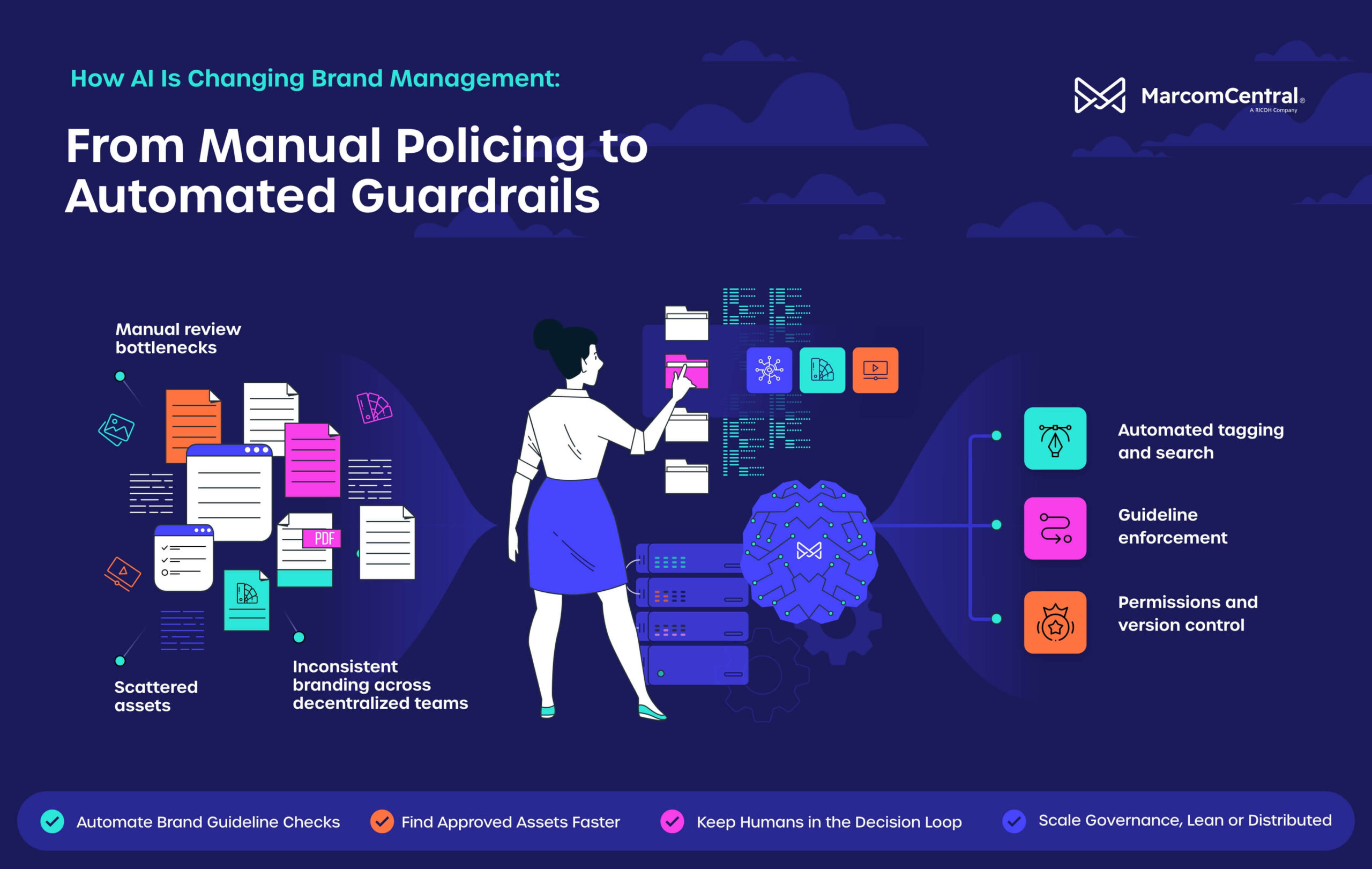
From Manual Brand Policing to Automated Guardrails
For years, businesses had to manually review brand assets, which is a tedious and time-consuming process. Marketing teams checked every campaign before going live, and designers searched through shared folders for approved logos. There was a delay at every turn, which made it nearly impossible to consistently be first in a field where speed matters. Even the most diligent brand teams would occasionally miss something.
AI changes that process by creating automated guardrails instead of relying on constant manual oversight. For example, AI can handle all of these crucial tasks:
- Detect outdated logos before publication
- Flag incorrect fonts or colors
- Identify duplicate or low-quality assets
- Recommend approved templates
- Suggest the correct product imagery
- Alert teams when required legal language is missing
- Organize assets using automated metadata
Instead of fixing problems after publication, marketing teams can prevent them from happening. Your organization will also benefit from centralized governance through AI-enabled digital asset management systems.
Employees will no longer have to search through a scattering of disconnected folders. Instead, everything will be stored in one trusted location.
Where Generative AI Fits (and Where It Doesn’t)
Generative AI has become one of the most visible applications of artificial intelligence in marketing. Your team can use these tools to draft blogs, create campaign ideas, and generate social captions in seconds. While the output is not publish-ready, it gives your team a great starting point to build on.
It’s important to keep in mind that generative AI needs to support your brand management efforts, not replace what talented people are doing behind the scenes. AI cannot fully understand a company’s culture, positioning, customer relationships, or long-term business goals. It predicts likely language patterns based on training data rather than making strategic brand decisions.
5 Ways AI Is Reshaping Core Brand Management Functions
Artificial intelligence affects nearly every stage of modern brand management. AI now supports creative production, governance, analytics, customer engagement, and operational efficiency. Organizations that integrate AI into structured workflows gain faster execution without sacrificing consistency or quality.
Here are five ways you can effectively use AI for brand management:
1. Enforcing Brand Guidelines Automatically
The bigger and more decentralized your brand becomes, the harder it is to maintain consistent branding. You can’t manually check over every piece of content before it’s published, especially if your company relies on regional offices or franchises. Each group needs the autonomy to customize content for its target audience, but your core brand voice can’t go by the wayside.
AI helps you enforce brand standards automatically by reviewing assets before they are published. Instead of relying on manual reviews, AI can verify whether creative materials follow approved guidelines for assets like these:
- Logos
- Colors
- Typography
- Messaging
- Image usage
- Required legal language
- Product naming conventions
Some systems also recognize outdated creative and recommend approved replacements automatically. These capabilities reduce review cycles while minimizing the risk of costly branding mistakes.
When your organization pairs AI with a centralized digital asset management platform, employees also gain immediate access to the latest approved assets rather than searching through outdated folders. The entire process becomes smoother and more efficient.
2. Predicting Brand Perception With Sentiment Analysis & Social Listening
The way people perceive your brand is constantly changing. Customers discuss products on social media platforms and online review hubs. If you aren’t actively listening to their feedback and analyzing sentiment, you could miss subtle shifts. Collectively, these conversations create more information than your marketing team can review manually.
AI analyzes these data sources in real time to identify emerging trends and shifts in customer sentiment. Rather than simply counting positive or negative comments, modern sentiment analysis identifies recurring themes and changes in public perception. Use these insights to refine your messaging and products to align with what customers want from your brand.
3. Personalizing Customer Experience at Scale
The idea that customers want personalization has been driven home for a decade or more. However, each time marketing technology levels up, so does your ability to customize the experience you deliver.
Using AI for brand management represents one of the biggest leaps forward in personalization in several years. AI can work on the back end, assisting your teams by handling these tasks:
- Recommending relevant products or services
- Delivering targeted email campaigns
- Customizing website content in real time
- Surfacing the right marketing assets for different customer groups
When your entire marketing ecosystem is connected, delivering campaigns that resonate with your customers becomes much more achievable. That’s the advantage that you unlock with AI-powered brand management tools.
4. Accelerating Asset Creation & Search
Your marketing team spends the majority of its time creating assets. All of those assets add up and create a quagmire that you can get lost in if the content is not searchable. At times, finding the correct file version becomes harder than creating a new one.
Artificial intelligence drastically improves asset management by automating organization and search. Instead of relying on manual file names and folders, consider what you can do with AI:
- Automatically generate and add metadata
- Tag images based on their contents
- Recognize products, logos, and people
- Detect duplicate assets
- Recommend related files
- Surface the latest approved versions
- Archive outdated materials
AI-powered search allows your marketing team to describe what they need, and the artificial intelligence software does the rest. Natural language searches save a tremendous amount of time while also connecting your employees with their resources.
5. Powering Smarter Campaign & SEO Decisions
The success of your campaigns hinges on the quality of your data. AI helps your business analyze information faster than traditional reporting methods so that you can unlock better insights more quickly and incorporate them into your marketing campaigns.
When you let AI take the lead on the analytics side, you don’t have to review dozens of dashboards manually. Your marketing team can leverage the information in a range of useful ways, including:
- Identifying high-performing content
- Predicting campaign performance
- Recommending keyword opportunities
- Detecting declining engagement
- Optimizing content publishing schedules
- Forecasting audience behavior
- Improving the efficiency of paid advertising efforts
AI can identify gaps in your content, channels, and marketing strategy. The most successful teams use AI to inform decisions and supplement the strategic insights of their most experienced members.
The Risks of Letting AI Make Brand Decisions Unsupervised
It’s true that artificial intelligence can deliver impressive efficiency gains. So if allowing AI to take over some processes is good, unleashing it across your entire workflow is even better, right? In some ways, yes. But that line of thinking can also get brands in trouble. When AI has too much marketing autonomy, it can go off the rails and erode brand equity.
You’ve forged your brand identity from years of customer relationships, marketing, and business decisions. AI can support these efforts, but it cannot replace thoughtful leadership. Companies that prioritize speed over governance introduce inconsistencies that weaken customer trust.
The reality is that even the most sophisticated AI marketing tools need to be governed appropriately. If you fail to vet AI content and review the strategy suggestions it delivers, you can erode brand equity.
Brand Consistency Drift Across Channels
One of the biggest risks of AI-generated content involves gradual inconsistency. Individual pieces of content may appear acceptable and on-brand on their own, but over time, they can shift away from the organization’s established voice, messaging, and visual identity.
Here’s what differences among AI tools can look like:
- Inconsistent product descriptions
- Different tones of voice
- Competing messaging
- Unapproved terminology
- Images that are off-brand
- Claims that are inaccurate or made up entirely
A few inconsistencies can multiply when you use AI to generate hundreds of marketing assets for all of your channels.
Data Privacy & Compliance Exposure
Most AI platforms run on prompts. Organizations that upload confidential materials into unsecured AI systems may expose proprietary or protected information.
Your marketing leadership must establish clear policies that outline what employees are and are not allowed to upload to AI. If you operate in a heavily regulated industry, implementing these guardrails is especially important.
Responsible AI adoption always includes security, compliance, and data governance. Cutting corners in any one of these areas can expose your business to significant liability.
Losing Brand Equity Through Generic Output
Generative AI learns from existing information. As a result, many outputs sound polished but remarkably alike. If every organization relies on similar prompts and the same language models, you’ll lose what makes your company unique. Strong brands stand apart because they communicate distinctive values and perspectives.
The creativity of your team remains a foundational part of your success. Your people should lead the way at these critical moments of the process:
- Defining brand positioning
- Developing campaign concepts
- Crafting emotional messaging
- Building customer relationships
When it comes to content creation, AI works best as a tool for generating drafts. You have to add the personality and voice that make your company one of a kind.
AI Brand Management Tool vs. AI-Enabled DAM: What’s the Difference?
Many businesses assume that any AI-powered marketing tool will solve their brand management challenges. In reality, different tools serve very different purposes. Here’s a look at the different categories so you can identify which solutions to incorporate into your mix.
Point AI Tools (Chatbots, Generative Content Tools)
Point AI tools help you generate content quickly. Your team can use them to brainstorm ideas and generate rough drafts in seconds. These tools cut down on repetitive work and free up more time for your team to flex their creativity, but they don’t solve the governance problem.
AI-Enhanced Digital Asset Management Systems
Digital asset management solutions (DAMs) that are backed by artificial intelligence turn your centralized content libraries into intelligent environments. AI-powered DAMs can automatically organize, classify, and surface the right assets when users need them.
These capabilities reduce wasted time while strengthening governance. You can protect your brand image and voice while connecting users to the most relevant assets.
Full Brand Governance Platforms
A comprehensive brand governance solution combines DAM capabilities with workflow automation, approval processes, permissions, customizable templates, and analytics. These platforms help your business tackle the following:
- Control who can access and edit assets
- Standardize marketing materials across every location
- Automate approval workflows
- Protect brand consistency
- Improve collaboration between teams
- Scale marketing without increasing administrative work
Rather than asking every employee to become a branding expert, governance platforms embed brand standards directly into your workflows. You can grow while maintaining a consistent customer experience.
How to Bring AI Into Your Brand Strategy Without Losing Control
Successful AI adoption starts with strategy first and technology second. To maintain control where it matters, consider implementing these best practices.
Start With Guardrails, Not Generation
Many organizations equip their employees with AI tools and ask them to ramp up production. Starting with governance is the stronger approach. Before you unleash AI, establish the following:
- Brand guidelines
- Approved messaging
- A centralized asset library
- User permissions
- Content approval workflows
- Compliance requirements
Once you set up these safeguards, AI can operate within clearly defined boundaries.
Keep Humans in the Loop for Strategy & Identity Decisions
Your marketing team should continue making decisions about voice, tone, customer messaging, and competitive differentiation. Assign marketing team members to review AI content before going live, even if it appears to be publish-ready.
Choose Tools Built for Governance, Not Just Speed
When evaluating prospective AI for brand management, prioritize platforms that offer strong governance, not just faster content creation. You need tight workflow management capabilities to protect the brand that you’ve built.
MarcomCentral for Every Team Size: Asset Management for SMBs and Large-Scale Organizations
MarcomCentral serves clients across many different industries. Our powerful tools can support small marketing teams, mid-sized businesses, and large enterprises that require tight governance across thousands of users. You can choose the MarcomCentral solution that best aligns with the size and scope of your business.
MarcomCentral Core — Guardrails for Lean, Single-Brand Teams
MarcomCentral Core provides centralized asset management, easy-to-use templates, and built-in brand guardrails you can count on. Your marketing team can quickly organize approved assets, control access, and simplify content distribution to deliver better experiences.
MarcomCentral — Governance at Scale for Distributed & Multi-Brand Organizations
MarcomCentral solves challenges for large enterprises. Our scalable and customizable governance tools deliver centralized DAM, user permissions, and AI-powered organization.
Ready to win the consistency battle in your industry? Request a demo and experience the capabilities of MarcomCentral today.
FAQs
How Do You Use AI in Brand Management?
You can use AI to automate repetitive tasks and organize your digital assets. Artificial intelligence also excels at generating rough drafts and taking care of redundant work. You’ll achieve the most success when you combine robust AI tools with strong governance and human oversight.
What’s the Difference Between an AI Brand Manager and a Digital Asset Management System?
An AI brand management tool primarily generates content and analyzes marketing data. A DAM stores, organizes, and distributes approved brand assets. AI-enhanced DAM platforms add intelligent search, automated tagging, and workflow automation.
What Are the Risks of Relying on AI for Brand Decisions?
If you become too reliant on artificial intelligence to make major brand decisions, messaging could become inconsistent or contain information that is outright false. Clear governance policies and approval workflows help reduce these risks while preserving the integrity of your brand.
What Are the Benefits of Using AI for Brand Sentiment Analysis?
AI analyzes a variety of sources, including social media and customer reviews, to identify trends and measure public perception. These insights help your marketing team respond more quickly and make more informed decisions.
You might also like