



Get news, updates, and insights delivered straight to your inbox.
Managing Brand Consistency in the Age of AI

Artificial intelligence is transforming how marketing teams create, manage, and distribute content. Tools powered by generative AI allow you to produce messages, visuals, and campaigns faster than ever before. While the speed of AI tools gives you a huge edge, it also introduces a new challenge: staying on-brand across every channel and piece of content. Using AI for brand consistency requires strong governance and clear brand guidelines. Otherwise, you will experience too much variability within outputs when using automation. AI-generated materials can quickly drift from your guidelines. Our guide outlines AI for brand consistency strategies that enable you to scale content creation without sacrificing brand integrity. Make sure all brand assets reflect your brand voice, visual identity, and messaging.
The New Reality: AI Is Reshaping Brand Content Creation
Generative AI has kicked content creation into warp speed. Marketing teams can produce significantly more assets than ever before. Tasks that once required days of writing, editing, and design can now be completed in minutes. This uptick in volume allows businesses to tap into more channels, including social media, LinkedIn, and email. However, speed and automation are outpacing traditional brand governance processes. AI for brand consistency strategies will help you walk the tight rope between efficiency and staying true to your voice. Achieving AI-powered brand consistency requires diligence and strict adherence to your brand standards. You also need to keep people in the equation so that they can review content. If you over-automate, there is a greater risk of fonts, tone of voice, or other elements getting out of alignment with your brand.
Why Brand Consistency Is Harder — and More Critical — Than Ever
Maintaining consistent branding has always been a challenge, but today’s marketing environment makes it even more complex. Marketing teams are using generative AI to pump out huge volumes of content in real-time, which means they are tapping into more channels and publishing with increasing frequency. Think about all of the different touchpoints you use during an average campaign. Your list likely includes things like your website, social media platforms, email, and advertising networks. At the same time, marketing teams are increasingly distributed across remote employees and agencies. All of these factors ramp up the risk of inconsistent messaging and visual identity. Using AI for brand consistency best practices has become a necessity. If your content deviates from the standard, it hurts trust and weakens brand equity. When you maintain the spirit of your messaging and stay on brand, consumers will view your brand as trustworthy, legitimate, and reliable.
The Risks of Using AI Without Brand Guardrails
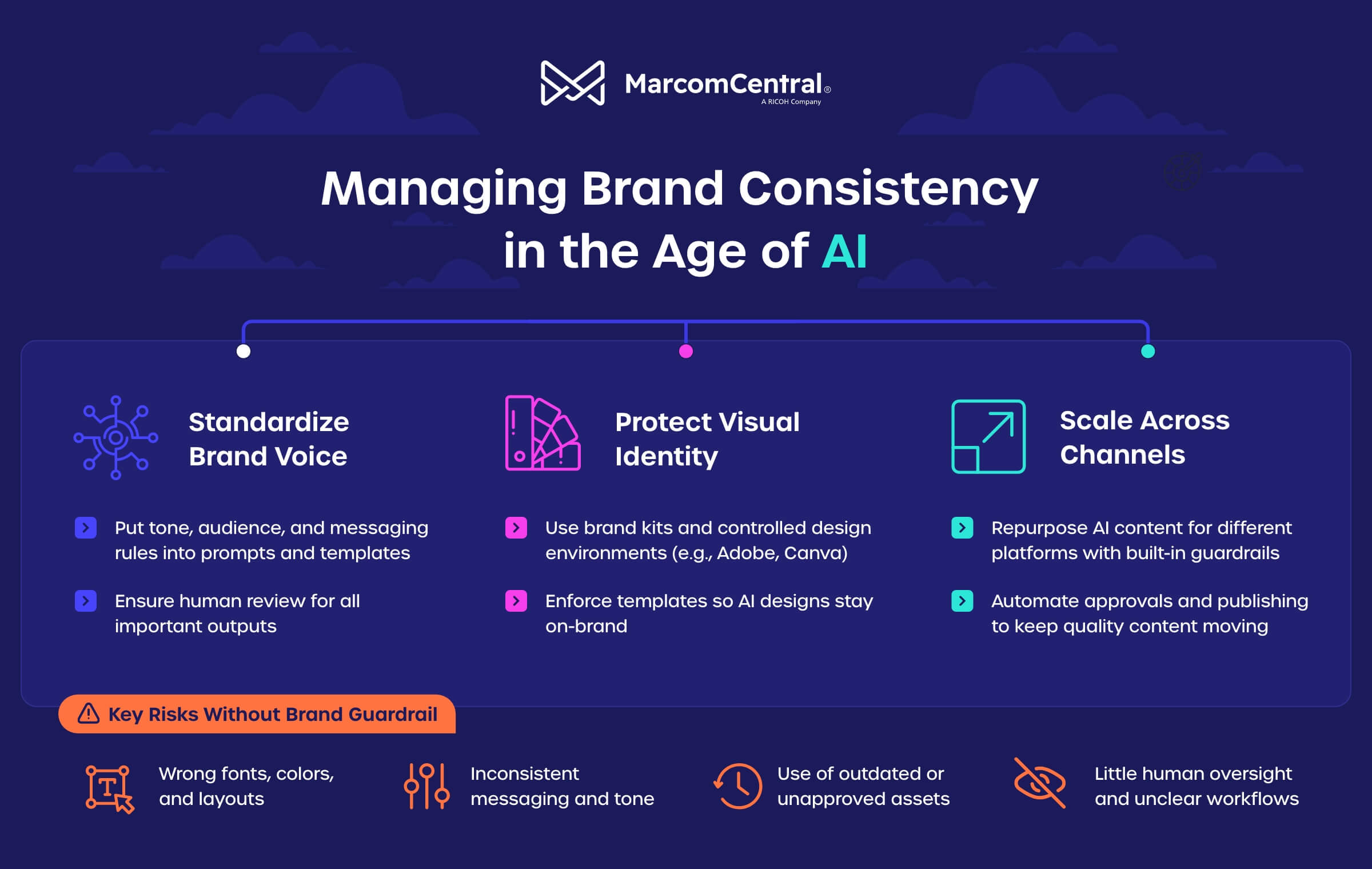
Turning artificial intelligence loose within your marketing processes without the right safety measures in place turns marketing into the Wild West. Your team will publish a huge volume of content, which can quickly drift from the established voice. Other risks of using AI without proper guardrails include:
- Incorrect use of fonts, typography, and color palettes
- Inconsistent messaging across campaigns and departments
- Misuse or duplication of outdated brand assets
- Lack of structured workflows and human oversight
- Increased governance challenges for your marketing team
If you are already using artificial intelligence, go back and make sure you have these measures in place. If you are exploring opportunities for AI-powered content creation, proactively implement guardrails so you can stop drift before it occurs.
What AI-Powered Brand Consistency Really Means
Using AI for brand consistency means embedding your brand standards directly into the systems that generate and distribute marketing content. Instead of manually correcting every piece of content when it is produced, you can build workflows that reference your structured brand guidelines from the start. This approach yields content that begins with the correct tone, messaging, and design parameters. Using approved templates is also a huge step in the right direction. While your team may still have to make some edits, these changes should be minor. Templates lock in brand elements, such as typography, colors, and layout structures, so that AI-generated designs remain visually consistent. Centralized asset management further strengthens alignment by ensuring teams use approved logos, images, and design elements. Together, you can use these systems and processes to achieve real-time brand governance. You’ll maintain tight control, even as AI drastically increases content production.
How Marketing Teams Can Use AI for Brand Consistency
AI-powered brand consistency tools are valuable for:
Standardizing Brand Voice With AI
One of the most effective uses of AI for brand consistency is standardizing messaging across all of your content. Whether someone is reading one of your social posts, skimming a blog, or interacting with a paid ad, the core voice should remain the same. The content should always feel like it came from your brand. Your marketing team can embed brand voice guidelines directly into AI prompts and templates. This includes messaging priorities, tone, and your target audience. By making your workflows structured and repeatable, you can ensure that AI-generated copy reflects the same voice across every blog post, email, and social media post. Remember, human review remains a critical part of the workflow. Your editors and brand managers should evaluate AI outputs to confirm that they align with your brand. With the right mix of prompts, templates, and oversight, AI for brand consistency can help you maintain high-quality messaging at scale.
Protecting Visual Identity at Scale
The look and feel of your content also needs to be consistent with what users have come to expect from your brand. Templates allow your team to lock in on fonts, enforce typography rules, and make sure logos are placed appropriately. When AI-generated visuals are created within these templates, off-brand designs are far less likely to occur. You can also use a controlled design environment like Adobe or Canva brand kits. These tools embed approved brand elements directly into the platform. Setting up guardrails helps distributed teams, including agencies and contractors, produce content quickly while still maintaining visual alignment. Using AI-powered brand consistency systems for design prevents fragmentation across campaigns and marketing channels.
Scaling Content Across Channels Without Losing Control
Repurposing AI-generated content across social media and LinkedIn allows you to get more out of each asset. Artificial intelligence tools are great for quickly repurposing or fine-tuning content for different use cases. When you use generative AI solutions with built-in guardrails, you can make these adjustments while exercising tight control and maintaining consistency. To further boost efficiency, use automation to streamline your approval and publishing workflows. That way, quality content will not get stuck in the pipeline simply because someone forgot to approve it. Integrating artificial intelligence in these ways allows you to execute at scale without compromising your brand values.
The Role of Human Oversight in an AI-Driven Workflow
Brands that embrace artificial intelligence for content creation and brand enforcement are in a position to thrive. However, they must also keep human oversight as a central component of their marketing strategies. AI does not replace the strategic thinking capabilities of your team. Human marketers are responsible for storytelling, differentiating your brand, and connecting with your audience. Use your team’s expertise to review brand standards and protect the reputation you’ve worked so hard to build. Support your efforts with clear governance processes and review various compliance metrics to promote ongoing alignment. The goal is to balance the benefits of automation with accountability.
Building an AI-Ready Brand Governance Framework
When constructing your brand governance framework to support the use of artificial intelligence for content creation, make sure that you:
- Audit your brand guidelines and style guides
- Centralize all of your assets and approved templates
- Define clear AI use cases and set boundaries for your team members
- Establish workflows that integrate automation and review
- Implement metrics to measure branding consistency across channels
Use the information you gather to optimize your processes as AI tools get smarter and more effective. Continually refine your governance framework to address any gaps and reduce the burden on your review team.
The Future of AI for Brand Consistency
Artificial intelligence is continually getting better, which means the opportunity to enforce your brand guidelines with AI is growing as well. Future tools will support real-time brand monitoring and compliance checks, allowing you to more effectively identify instances where content deviates from your standards. Over time, automation tools will get smarter and more adaptive as well. They can keep up with your changing brand standards while allowing for greater personalization. AI is also being integrated into brand management ecosystems, which sets the stage for a strategic partnership between artificial intelligence and human teams. If you are ready to embrace the future of AI for brand consistency, MarcomCentral is an ideal partner. Our innovative asset management tools keep your content organized, accessible, and visible. Request a demo of MarcomCentral today and protect your brand identity.
FAQs
What Is AI-Powered Brand Consistency?
AI-powered brand consistency means using artificial intelligence tools and automation to keep your marketing content in alignment with your brand guidelines. AI allows you to create a larger volume of content than ever before. These consistency solutions help solve the problem created by the sharp rise in content creation volume. Using AI for brand consistency embeds your voice, visual identity rules, and messaging framework directly into content creation tools. The result is scalable content creation with consistent branding.
How Can AI Improve Brand Management?
Artificial intelligence enhances key brand elements by embedding them into every asset. Additionally, you can automate tedious tasks, such as core design processes, which gives your content team more time to flex their creativity, monitor campaign performance, and build better assets for your audience. AI helps your team scale production without deviating from your core messaging and visual identity. The result is a larger volume of high-quality deliverables for all of your core touchpoints. You can expand the scope of your campaigns, reach your audience on their preferred platforms, and build brand equity through consistent posting.
Can AI Maintain Brand Voice Across Campaigns?
Yes, you can use artificial intelligence to support a consistent brand voice. However, you have to embed insights from your style guides into the generative tools. To optimize the way you create content with AI, add templates, typography, fonts, colors, and other specific brand elements to your generative tool. Additionally, keep human review processes central to content management. Your team members act as a final layer of protection against content that goes off the rails. If something is off, they can make corrections before the content ever reaches your target audience. This is especially important when using AI tools like ChatGPT or Canva.
How Do You Prevent Off-Brand AI-Generated Content?
Your organization can prevent off-brand content by embedding your brand standards into templates and maintaining centralized asset libraries. You also need to maintain a centralized content library to promote cohesive asset management. When all of your assets are searchable and organized, it will streamline how you find, deploy, and optimize deliverables. The bottom line is that you need solid guardrails that support efficient content creation while also protecting your brand integrity.
Does AI Replace Human Creativity in Branding?
No. Artificial intelligence amplifies the creativity of your marketing team. It does not replace them. Your team members are still responsible for brainstorming ideas, telling compelling stories, and differentiating your brand with creativity. The most effective marketing workflows combine AI tools with experienced marketers and brand managers. When deploying AI tools into your content creation workflows, get your marketing team involved early and often. Engage them in the tool selection process and find out what features they would like to see in your artificial intelligence solution. After all, they are the ones who will be using it every day. Make sure they are excited about the process.
What Metrics Should Teams Track to Measure Brand Consistency?
Your team should track metrics such as brand compliance rates, asset reuse rates, and content creation time. Ideally, AI-generated content should have a high compliance rate and only require minor edits. If your team has to make major modifications to every piece of AI-generated content, it is losing time and falling behind the competition. Monitoring these indicators helps you maximize the efficiency benefits of generative AI tools while staying on brand.
You might also like


AI in MarTech: How Intelligent Marketing Technology Is Reshaping Brand Management
Read More