


Get news, updates, and insights delivered straight to your inbox.
Where AI Content Governance Breaks Down Across Franchise & Partner Networks (and How DAM Fixes It)

Written by Matt Wallace
AI content governance encompasses the frameworks, review workflows, and platform safeguards that establish permissible messaging, visual standards, and distribution channels for machine-generated assets. Maintaining these standards within a single corporate team presents distinct challenges. Across distributed networks of franchise locations, independent dealers, and retail partners equipped with accessible artificial intelligence, governance systems consistently collapse at identifiable points.
Adoption is no longer the question. Nearly nine in ten respondents to McKinsey’s 2026 State of AI survey report regular use of AI in at least one business function. The real question is whether the content your network produces with those tools still belongs to your brand.
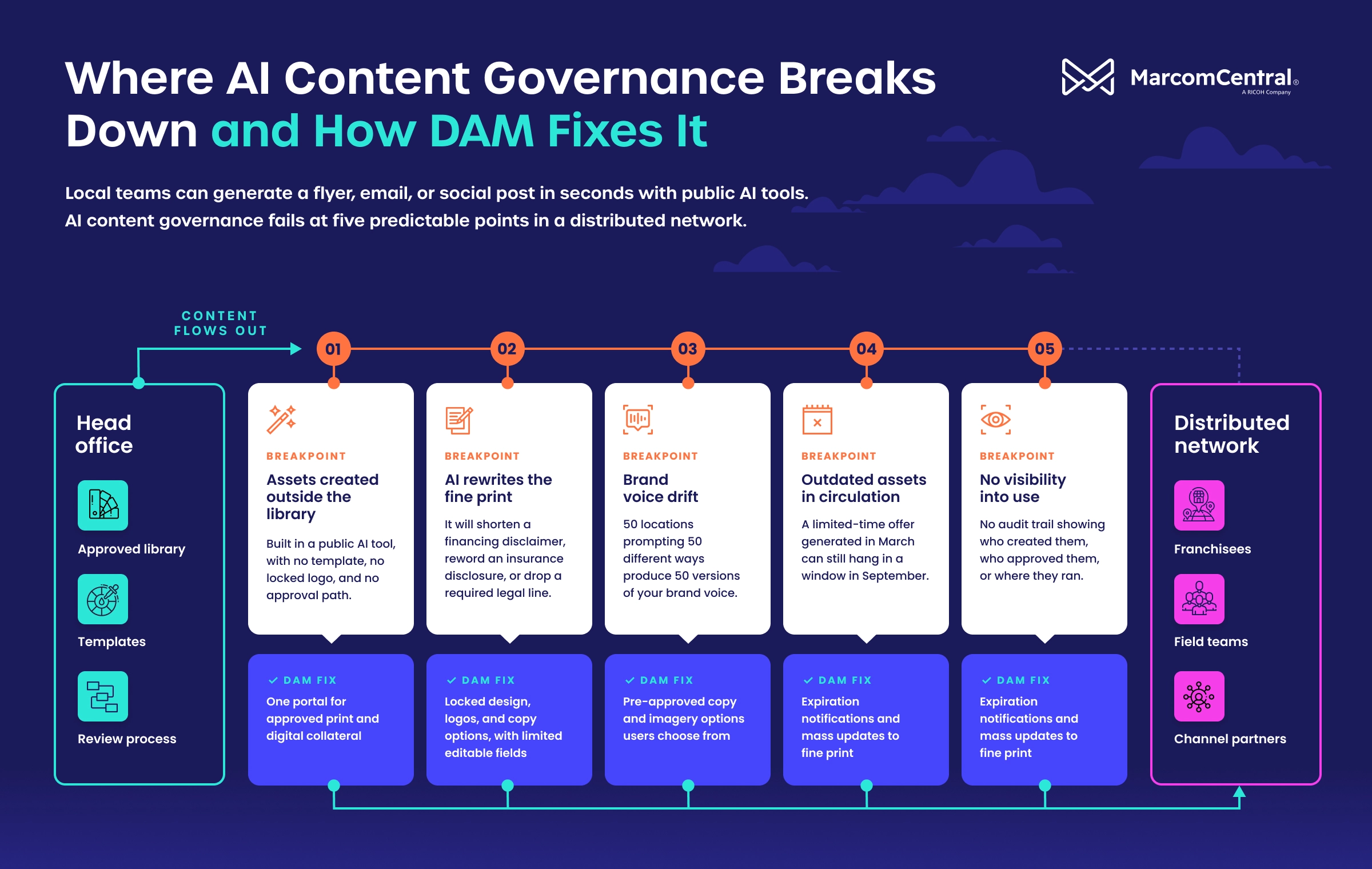
Below are the five points where governance fails in a distributed network and what the EU AI Act now expects. You will also see how a digital asset management (DAM) platform closes each gap. If you run marketing for a franchise system, see how franchise brands use MarcomCentral to keep local materials on brand.
What Is AI Content Governance?
AI content governance is the policy and workflow layer that controls how AI-generated content is created, reviewed, approved, and retired. It sets what AI can draft, which elements it can never change, who signs off, and how you track what was used. Think of it as content governance with a very fast new contributor on the team.
It is narrower than AI governance. AI governance covers the systems themselves: data security, privacy, bias, and how a company selects and deploys AI models. AI content governance starts with the output, meaning the flyer, email, social post, or sell sheet someone generated and wants to publish. If your team is still building its foundation, start with our AI marketing basics guide.
Why Franchise and Partner Networks Break Content Governance First
Distributed networks break first because the people creating content sit outside head office’s direct control. A franchisee owns their business. A channel partner answers to its own leadership. Neither needs permission to open ChatGPT and ask for a grand opening flyer.
That independence is the strength of the model, and it is also the governance problem. Head office sets the brand standard, but it is not in the room at 10 p.m. when a local owner writes Saturday’s promotion. When the approved asset is harder to reach than a chatbot, the chatbot wins.
The pre-AI version of this problem already had a name: rogue marketing materials. Generative AI did not invent it. It made rogue materials faster to produce and harder to spot, because they now look polished.
5 Places Governance Breaks Down in a Distributed Network
Most governance failures in a franchise or partner network trace back to five gaps. Each one has a clear fix, and none of them require banning AI.
1. Local Teams Create Assets Outside the Approved Library
The first break happens before any review can. A franchisee who cannot find an approved flyer builds one in a public AI tool, with no template, no locked logo, and no approval path. Head office never sees it until a customer does.
The fix is access, not policing. When the approved version is faster to get than the AI version, most local teams take it.
2. AI Rewrites the Fine Print
Generative AI treats every word as editable, including the words that are not. It will shorten a financing disclaimer, reword an insurance disclosure, or drop a required legal line to make copy fit. In a regulated industry, that one edit turns a marketing asset into a compliance issue.
Regulated elements need to sit in fields that neither AI nor local users can touch. Our guide to how highly regulated industries stop rogue sales collateral covers this in more depth.
3. Local Promotions Drift From the Brand Voice
AI tools write in a generic, upbeat voice unless someone guides them. A network of 50 locations prompting 50 different ways produces 50 versions of your brand voice. None may be wrong on its own. Together, they wear down the brand consistency customers use to recognize you.
4. Outdated Assets Stay in Circulation
AI makes content easy to create and does nothing to retire it. A limited-time offer generated in March can still hang in a window in September. Without expiration dates, nobody pulls it, and an old price or retired logo keeps working against you.
5. Nobody Can See What the Network Actually Used
You cannot govern what you cannot see. Assets made outside your platform leave no audit trail showing who created them, who approved them, or where they ran. When legal, a partner, or a regulator asks, there is no record to hand over.
What Does the EU AI Act Require for AI-Generated Content?
According to the European Commission, the transparency rules in Article 50 of the EU AI Act apply from August 2, 2026. Providers of generative AI must mark outputs as AI-generated in a machine-readable way. Deployers must disclose deepfakes and label AI-generated text published to inform the public on matters of public interest.
Most promotional copy is not public-interest text, but AI imagery can still be in scope. The Act defines a deep fake as AI-generated or manipulated image, audio, or video content that resembles existing persons, objects, places, entities, or events and would falsely appear authentic. An AI photo of a real storefront or a realistic spokesperson deserves a closer look.
Human oversight now carries regulatory weight. The Commission’s guidance exempts text under human review or editorial control from the text-labeling rule, and it states that superficial checks such as spell-checking do not qualify. An approval step with a real reviewer is now a compliance control, not just a brand preference. This is general information, so confirm your network’s specific regulatory requirements with legal counsel.
How DAM Fixes Governance Across Distributed Networks
A DAM fixes these gaps by making the governed path the fastest path. Approved assets, locked templates, approval routing, and usage data live in one portal, so local teams get speed and head office keeps control. Here is how each break point maps to MarcomCentral, our distributed marketing and digital asset management software.
| Break Point | Governance Fix | Where It Lives |
|---|---|---|
| Assets created outside the library | One portal for approved print and digital collateral | Brand Management Portal |
| AI rewrites the fine print | Locked design, logos, and copy options, with limited editable fields | Custom Dynamic Templates |
| Brand voice drift | Pre-approved copy and imagery options users choose from | Custom Dynamic Templates |
| Outdated assets in circulation | Expiration notifications and mass updates to fine print | Clear Compliance |
| No visibility into use | Views, downloads, and access by user and region | Usage Analytics & Insights |
Give the Network One Place to Start
The Brand Management Portal puts approved collateral in one centralized hub, which removes the version control problem of files scattered across inboxes and shared drives. Keyword tagging and metadata make assets findable, so local teams search instead of starting from a blank prompt.
Lock What AI Should Never Change
Custom Dynamic Templates let head office lock template design, logos, color schemes, and approved copy and imagery options. Local users customize text fields and choose from approved options through drop-down menus, with no design skills needed. When a disclaimer lives in a locked element, nobody can rewrite it.
Route Every Customized Asset to an Approver
Clear Compliance adds the review layer. Approval workflows notify an approver when an asset has been customized or needs sign-off. Access controls decide which users and groups can see specific collections. Mass updates change fine print across every relevant asset at once, and expiration notifications flag assets before they age out of field use.
Keep AI Generation Inside the Portal
Through the OpenAI integration, Admins generate original images from text prompts inside the MarcomCentral Library, without leaving the MarcomCentral environment. Only Admins can create these images, so they are approved as soon as they’re added to the library. Creation and approval happen in one step, which means on-brand imagery reaches your network faster and doesn’t add to approval queues.
See What Every Location Uses
Usage Analytics & Insights shows how often and by whom assets are accessed, plus the regions and locations accessing them. To see locked templates and approval routing on your own collateral, get a demo built around your network.
How to Build an AI Content Governance Framework for Your Network
Start with rules the network can follow without a manual, then build those rules into the tools. These five steps cover most franchise and partner systems.
- Define what AI can and cannot touch. List what AI may draft, such as headlines, captions, and local event details, and what it never changes, such as logos, disclaimers, pricing terms, and regulated claims.
- Lock the untouchable elements in templates. Move every regulated or brand-critical element into locked template fields, so the rule enforces itself.
- Route AI-assisted assets to a named approver. Give a real reviewer the authority to approve, change, or reject each asset before it goes live.
- Set expiration dates at upload. Every time-bound offer gets an end date, so outdated assets leave field use on schedule.
- Review usage data every month. A location pulling few approved assets is often making its own.
Governance frameworks fail when they live only in a PDF. They hold when the approval workflows, templates, and expiration rules run inside the platform your network already uses.
Give Your Network AI Speed Without Giving Up the Brand
AI is not leaving your franchise or partner network, and it should not. The goal of governance is to put that speed inside a system where the brand, the fine print, and the approval record stay intact. MarcomCentral gives head office one portal for approved assets, locked templates, and approvals, and gives every location a faster path than a blank chatbot prompt.
Get a Demo to see how MarcomCentral keeps AI-generated content on brand across your network.
Frequently Asked Questions
What Does AI Content Governance Mean?
AI content governance means the policies, approvals, and platform controls that decide what AI-generated marketing content can say, how it must look, who approves it, and when it expires. It applies brand and compliance rules to content people create with generative AI tools. In a franchise or partner network, it keeps local content on brand without slowing local teams down.
How Is AI Content Governance Different From AI Governance?
AI governance manages the AI systems themselves, including data security, privacy, bias, and how models are chosen and deployed. AI content governance manages what those systems produce once someone wants to publish it. Marketing typically owns content governance, while IT, legal, and data teams own the broader AI governance program.
How Can AI Content Governance Be Enforced Across Distributed Marketing Teams?
Enforce it in the tools, not in a policy document. Give local teams one portal of approved assets, lock regulated elements inside templates, and route every customized asset to an approver before use. Usage data then shows where teams rely on approved assets and where gaps remain. Learn more about how distributed marketing works at scale.
What Does the EU AI Act Require for AI-Generated Marketing Content?
Article 50 of the EU AI Act applies from August 2, 2026. It requires deployers to disclose deepfakes and to label AI-generated text published to inform the public on matters of public interest. Providers of generative AI must also mark outputs in a machine-readable way. Text under genuine human review or editorial control is exempt from the text-labeling rule, so confirm your obligations with legal counsel.
Can Franchisees Use AI Tools and Still Stay on Brand?
Yes, when AI works alongside approved templates instead of replacing them. In MarcomCentral’s Custom Dynamic Templates, franchisees localize text fields and choose approved imagery while logos, colors, and locked copy stay fixed. Approval workflows can then send the customized asset to an approver, so speed and control come from the same workflow.
How Does MarcomCentral Keep Local Marketing Assets Compliant?
MarcomCentral’s Clear Compliance tools combine approval workflows, access controls by user and group, mass updates to fine print, and expiration notifications. Head office updates a disclaimer once, and the change applies across every relevant asset. Get a Demo to see it working on your own collateral.
What Should a Franchise AI Content Policy Include?
A franchise AI content policy should name the approved AI tools, list what AI may draft and what it may never change, and define who approves AI-assisted assets. It should also set expiration rules for time-bound offers and explain how usage is monitored. Keep it short enough that franchisees read it, and enforce the rest through templates. Our overview of franchise marketing covers the wider program.
Matt Wallace
General Manager
Matt Wallace is General Manager of MarcomCentral, which he joined in 2021 as Vice President of Marketing, and brings more than 20 years of experience leading marketing and product teams at B2B technology companies across digital transformation, data center, PaaS, and telecom.
You might also like

When to Move Off Dropbox and Shared Drives: A Brand Portal Software Readiness Checklist
Read More
